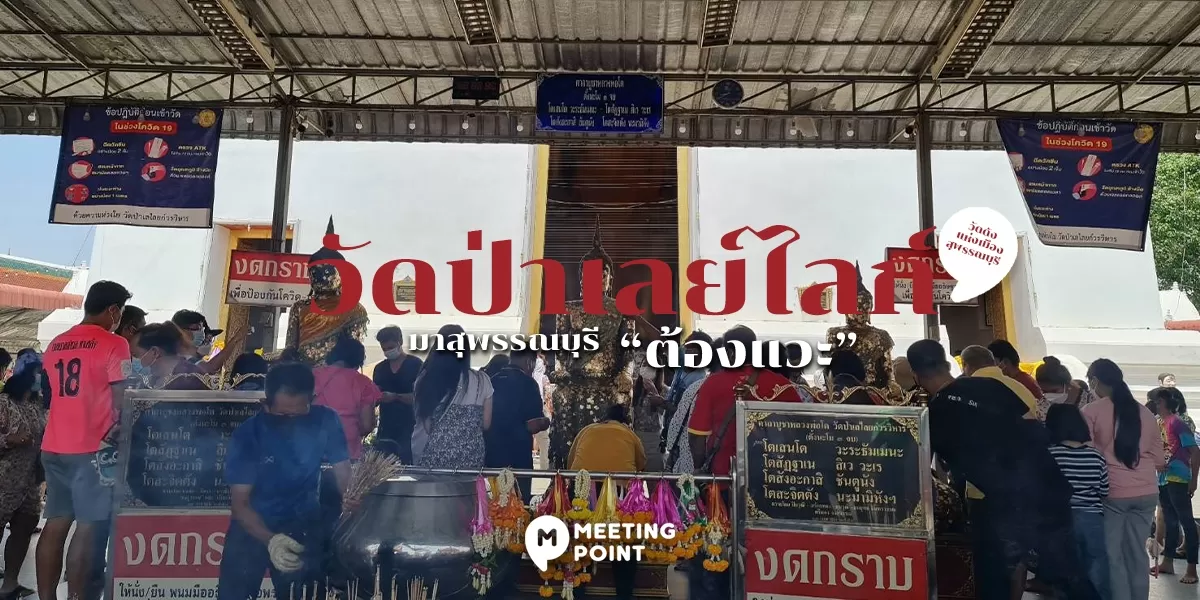
Wat Pa Lelai Worawihan: Suphanburi's Must-Visit Temple of Luang Pho To
They say you haven't really been to Suphanburi until you have visited Wat Pa Lelai. Today we pay respects to Luang Pho To and explore Khun Chang's House.
 Meeting Point Management Team
Published · Updated
4 min read
1,404 views
Quick answer
Wat Pa Lelai Worawihan is on Malaiman Road, Rua Yai, Mueang Suphanburi. This third-class royal temple, thought to be around 1,200 years old, houses Luang Pho To, a 23.47-metre seated Buddha. It also has Khun Chang Khun Phaen murals and Khun Chang's House, a teak Thai house.
Key takeaways
- An ancient temple, around 1,200 years old, closely tied to Suphanburi's identity
- Luang Pho To, a 23.47-metre seated Buddha said to hold 36 relics
- Murals of the Khun Chang Khun Phaen epic around the vihara
- Khun Chang's House, a teak Thai house displaying old household items
- Restored three times, including under King Rama IV
Contents
Wat Pa Lelai Worawihan is one of Suphanburi's most famous temples. People say that if you visit Suphanburi without stopping here, it is as if you never arrived, because this is an important temple that has long been part of the city's identity, with a long history.

Today we are taking you to Suphanburi. Wat Pa Lelai Worawihan draws crowds of visitors and is one of the most popular places in the province. On holidays, many people come to pray, admire the beautiful Luang Pho To and pay respects for good fortune.
History of Wat Pa Lelai Worawihan
This is an old temple, believed to be around 1,200 years old. It stands on Malaiman Road in Rua Yai subdistrict, Mueang district, Suphanburi, and locals simply call it Wat Pa. The vihara houses Luang Pho To in the Pa Lelai posture, a huge brick-and-stucco Buddha image that stands 23.47 metres tall.
The Northern Chronicles record that a king named Phra Chao Kalae, descended from the line of Hongsawadi, came to the throne and restored three temples, Wat Prot Sat, Wat Phu Khao Thong and Wat Yai. He then sent Mon Noi, of his own lineage, to build Wat Sanam Chai and restore the Phra Pa Lelai at Wat Lan Makhwit in the town of Phanthumburi. When the restoration was finished, two thousand officials were ordained together, so the town was renamed Song Phan Buri, "city of two thousand". The king set aside land for the temple, reigned for 40 years and died in Chula Sakarat 565 (given as B.E. 1724), a Year of the Tiger.
Luang Pho To is a Buddha image in the Pa Lelai posture, seated with legs lowered, in U Thong (Suvarnabhumi) style. Several scholars say it was probably first a Buddha in the posture of the First Sermon, built in the open air like the early Phra Phanan Choeng, and later restored and remade into the Pa Lelai posture we see today. Inside the image are 36 relics of the Buddha, obtained from the great elder Phra Maha Thera Laiyalai.
Wat Pa Lelai is connected with famous works of Thai literature: the epic Khun Chang Khun Phaen and Sunthorn Phu's travel poem Nirat Mueang Suphan. Today the temple covers 82 rai 1 ngan and is a third-class royal temple of the Worawihan type, with the full name Wat Pa Lelai Worawihan.

Three restorations of Luang Pho To
- The first, in B.E. 1706, by Mon Noi.
- The second, in the late Ayutthaya period, when King Suriyat Amarin, the last king of Ayutthaya, ordered Phraya Siharat Dechochai to build the vihara of Wat Pa Lelai.
- The third, under King Mongkut (Rama IV) of the Rattanakosin era, who sent Phraya Nikonbodin to restore it.
The restoration under King Rama IV came about because, before he became king, while he was a monk on pilgrimage to Suphanburi to pay respects to Luang Pho To, he found Wat Pa Lelai abandoned, with no monks living there to look after it, and badly decayed. After paying respects to Luang Pho To, he vowed that if he ever came to the throne, he would restore the temple as an offering.
During his reign, he ordered Phraya Nikonbodin to restore Wat Pa Lelai. A canal was dug from Wat Pratu San on the Suphan River so that teak logs could be floated all the way to the temple. Two-tier roofs were built on each side, outer walls were added, making five roof tiers on each side of the vihara in total, and Luang Pho To was repaired. Two more Buddha images were made and placed in front of Luang Pho To on the left and right, and the royal crown emblem of King Mongkut was set on the vihara's gable as his mark.
Khun Chang Khun Phaen murals
Around the vihara of Luang Pho To are murals telling the story of Khun Chang and Khun Phaen from beginning to end. They are beautiful and educational too.

The Khun Chang Khun Phaen epic
In the story, Nang Thong Prasri takes Phlai Kaeo to live in Kanchanaburi, where she saves until she becomes wealthy. When Phlai Kaeo grows up, he is ordained as a novice and comes to study magic and the Maha Chat sermon with Abbot Mi of Wat Pa Lelai. To preserve this heritage, the temple holds a Maha Chat sermon every year and built Khun Chang's House, a teak Thai house, so younger generations can come and learn.
Khun Chang's House
This traditional Thai house stands inside the temple grounds. It is a large, spacious teak house modelled on Khun Chang's home in the epic. Upstairs you will find a painting of the character Khun Chang where you can take a souvenir photo. Each room has illustrations telling the Khun Chang Khun Phaen story, along with displays of old household items, and the grounds are nicely landscaped. You come to sightsee and pray, and leave knowing more too.
So what do you think of Wat Pa Lelai Worawihan in Suphanburi? As they say, if you visit Suphan and skip it, it is like you never really arrived.
FAQ
Where is Wat Pa Lelai Worawihan?
On Malaiman Road, Rua Yai subdistrict, Mueang district, Suphanburi.
How tall is Luang Pho To?
23.47 metres. It is a large brick-and-stucco Buddha in the Pa Lelai posture, seated with legs lowered, in U Thong style.
How is the temple linked to Khun Chang Khun Phaen?
In the epic, Phlai Kaeo is ordained as a novice and studies magic with Abbot Mi of Wat Pa Lelai, so the temple has murals of the story and a replica of Khun Chang's House.
What else is there to see?
The Khun Chang Khun Phaen murals around the vihara and Khun Chang's House, a large teak Thai house with old household items on display.
The Meeting Point management team loves eating, travelling, temple visits and lifestyle. We pick the restaurants, cafes, stays, attractions and temples we have visited ourselves and write about them honestly.