Phra Pathom Chedi: Paying Respect at Thailand's Largest Stupa
Phra Pathom Chedi in Nakhon Pathom is the largest stupa in Thailand, an easy trip from Bangkok and a popular place to pay respects for good fortune.
 Meeting Point Management Team
Published · Updated
6 min read
2,636 views
Quick answer
Phra Pathom Chedi stands in Wat Phra Pathom Chedi Ratchaworamahawihan on Thesa Road, Mueang Nakhon Pathom. It's Thailand's largest bell-shaped stupa, about 120.5 meters tall, built over an older chedi during the reigns of King Rama IV and Rama V. Key sights include the Phra Ruang Rojanarit Buddha, the Buddha relics and Takhian Thong Cave. Open 7am to 8pm; foreigners pay 40 baht.
Key takeaways
- Thailand's largest stupa: about 120.5 m tall with a base circumference of about 233 m
- The current chedi was begun in 1853 and finished in 1870, taking 17 years
- Must-sees: Phra Ruang Rojanarit, the Buddha relics, the reclining Buddha and Takhian Thong Cave
- The annual Phra Pathom Chedi festival runs 9 days and nights, around November
- Open 7am to 8pm; foreigners 40 baht; tel 034 242 143
Contents
- Phra Pathom Chedi
- Phra Ruang Rojanarit
- Buddha relics
- Somdet Phutthachan To
- Murals
- Chao Pho Prasat Thong Shrine
- White stone Buddha images
- Reclining Buddha
- Replica of the old chedi
- Ordination hall and Luang Phor Prathan Phon
- Cloister
- Chao Pho Suea Shrine
- Takhian Thong Cave
- Uma Devi
- Maha Chok Cave
- Nam Thip Cave
- Wat Phra Pathom Chedi Museum
- Chinese stone figures
- Phra Pathom Chedi information
Today Meeting Point is taking you just outside Bangkok to pay respects at Phra Pathom Chedi in Nakhon Pathom, for a little extra good fortune. It's easy to get to and not far from Bangkok.
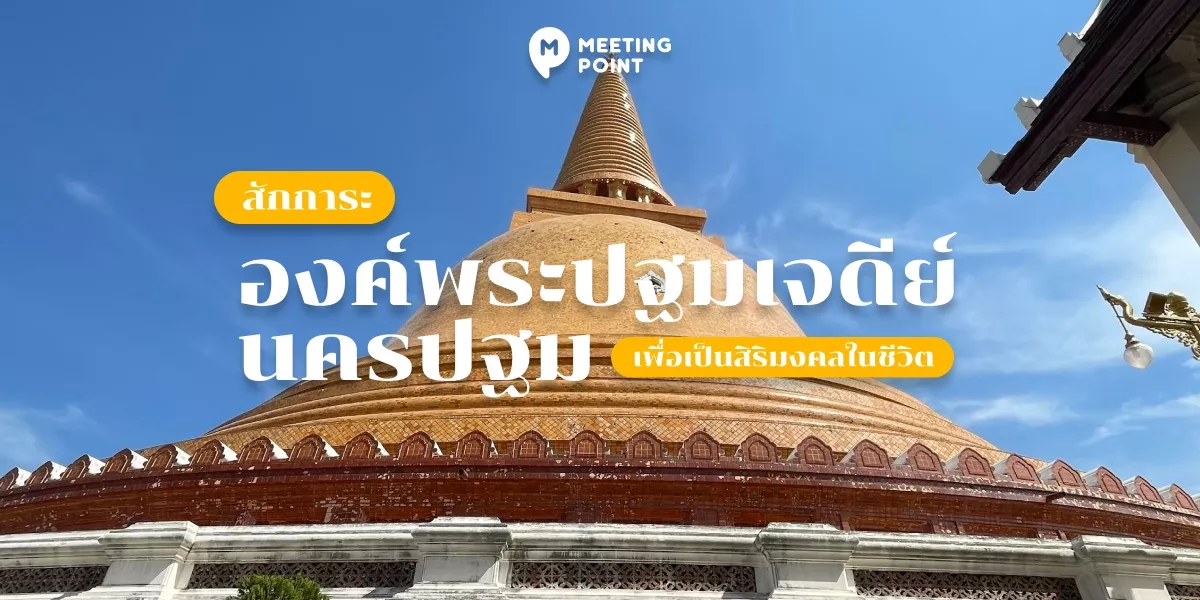
First, let's get to know Phra Pathom Chedi, which locals simply call "Ong Phra". It stands inside Wat Phra Pathom Chedi Ratchaworamahawihan in Phra Pathom Chedi subdistrict, Mueang Nakhon Pathom, Nakhon Pathom. It's a landmark that has been famous for a very long time. It is the largest stupa in Thailand, and Nakhon Pathom uses it as the provincial emblem.

The chedi you see today was built in the reign of King Rama IV, starting in 1853 (B.E. 2396). The king ordered a new chedi to be built over the original one, an ancient stupa with an inverted-bowl base topped by a prang spire. That original is believed to date to the early 4th century of the Buddhist Era, because its inverted-bowl shape resembles the Sanchi Stupa in India, built in the time of Emperor Ashoka. The new chedi was completed in the reign of King Rama V in 1870 (B.E. 2413), after 17 years of construction. It is a round, Sri Lankan-style inverted-bell chedi, standing 3 sen, 1 khuep and 10 niw (about 120.5 meters) from the ground to the top of its crown, with a base circumference of 5 sen, 17 wa and 3 sok (about 233 meters). Buddha relics are enshrined inside. Later, King Rama VI restored the temple to make it even grander, and Wat Phra Pathom Chedi is regarded as the temple of his reign.

As for beliefs and worship, paying homage at Phra Pathom Chedi is considered very auspicious and brings great merit, because it enshrines relics of the Buddha. The people of Nakhon Pathom also believe that the Phra Ruang Rojanarit Buddha image is especially sacred, and that wishes made before it tend to come true.

There's a lot to see at Phra Pathom Chedi, so Meeting Point has put together the highlights you shouldn't miss.

Phra Pathom Chedi
Phra Pathom Chedi is the largest great stupa in Thailand. It was originally called "Phra Thom Chedi". Its history goes back to the Suvarnabhumi era: it is thought to have been built when Emperor Ashoka's missionary monks came to spread Buddhism in Suvarnabhumi. It's a huge bell-shaped stupa whose original structure was made of logs bound with heavy chains and built of brick. It was first restored by King Mongkut (Rama IV), who, while still a monk on pilgrimage, found the chedi old, damaged and in ruins.

Phra Ruang Rojanarit
Phra Ruang Rojanarit is a standing Buddha image in the "pacifying the relatives" posture, in Sukhothai style, standing on a brass base decorated with lotus petals. The face is long and the feet are not quite level. It is revered by the people of Nakhon Pathom and Thai Buddhists everywhere. Its full official name is Phra Ruang Rojanarit Si Inthrathit Thammophat Mahawachirawut Ratchapuchaniyabophit, but most people call it "Luang Phor Phra Ruang" or simply "Phra Ruang Rojanarit".
Buddha relics
The Buddha relics are kept in the eastern vihara, the Phra Wihan Luang. During Songkran they are brought out in front of the chedi so the public and visitors can pour water over them in reverence.
Somdet Phutthachan To
Takhian Thong Cave also houses an image of Somdet Phutthachan To. When you visit, don't forget to go in and pay your respects.
Murals
Each vihara at the temple has beautiful murals. In the southern Wihan Luang there's a rare painting showing the inside of the chedi, from its original form as a stupa with a prang spire to the bell shape of today. There's also a gathering of deities, painted with very lifelike faces, bodies and poses, just as stunning.
Chao Pho Prasat Thong Shrine
The Chao Pho Prasat Thong Shrine is outside the cloister. Walk down a cave-like passage and you'll find this Chinese shrine, decorated with offerings of lotus flowers and victory flags for merit.
White stone Buddha images
These Dvaravati-era Buddha images sit with their feet down in the "first sermon" posture and are three times life size. Four were excavated at Wat Phra Men, an old Dvaravati temple more than a thousand years old. They are kept at Nanda Uthayan park in Huai Chorakhe subdistrict, Mueang Nakhon Pathom, a short distance south of the chedi.
Reclining Buddha
This beautiful 17-meter reclining Buddha was commissioned by King Rama IV as the principal image of the western vihara.
Replica of the old chedi
Phra Pathom Chedi has been built and restored four times, each time encasing the previous chedi, until it took its current form under King Rama V. This replica, south of the main chedi, shows what the earlier chedi looked like.
Ordination hall and Luang Phor Prathan Phon
The main ordination hall is a modern building restored in the reign of King Rama VII by Prince Naris (Somdet Chao Fa Krom Phraya Naris Ranuwattiwong). Its principal image, "Luang Phor Prathan Phon", resembles the southern Buddha images: a large white stone Buddha in the subduing Mara posture.
Cloister
A circular cloister surrounds the base of the chedi. At each of the four cardinal points there's a vihara, and inside the cloister is the circumambulation terrace, followed by the tiers of the base.
Chao Pho Suea Shrine
The Chao Pho Suea (Tiger God) Shrine is outside the cloister, near the Chao Pho Prasat Thong Shrine.
Takhian Thong Cave
Takhian Thong Cave has a fairly wide passage. Inside, it splits into two paths: Maha Chok Cave and Nam Thip Cave.
Uma Devi
Near the Chao Pho Prasat Thong and Chao Pho Suea shrines is an image of Uma Devi (Phra Mae Uma Mahathewi), where you can pay respects and make wishes.
Maha Chok Cave
Inside Takhian Thong Cave, turn left for Maha Chok Cave, home of Chao Mae Takhian Thong.
Nam Thip Cave
Turn right inside Takhian Thong Cave for Nam Thip Cave, which houses Mae Phra Thorani, the earth goddess.
Wat Phra Pathom Chedi Museum
The museum is on the lower terrace on the east side, opposite the ordination hall. It displays many antiquities and also holds the coffin of Ya Le, King Rama VI's beloved dog, as well as an altar table used in funeral rites.
Chinese stone figures
Chinese stone figures arrived in Thailand during the reign of King Rama III. Chinese junks trading with Thailand used them as ballast to keep ships steady in storms. As trade grew, so did the number of figures, and King Rama III had them placed as decorations in temples.
And the highlight you can't miss is the annual Phra Pathom Chedi festival, held from the 12th day of the waxing moon to the 15th day of the waning moon of the 12th lunar month (around November), for 9 days and 9 nights. It's a huge, spectacular event. Meeting Point has been, and it's truly wow. Wait for the next one and make sure you go.
Phra Pathom Chedi in Nakhon Pathom is open from 7:00am to 8:00pm. Foreign visitors pay a 40-baht entrance fee. For more details, contact the Phra Pathom Chedi office (Samnakngan Chat Prayot lae Raksa Ong Phra Pathom Chedi) on 0 3424 2143.
Phra Pathom Chedi information
Address: 27 Thesa Road, Phra Pathom Chedi, Mueang Nakhon Pathom, Nakhon Pathom 73000
Map: https://goo.gl/maps/rwcgXrGFfMvccVRe6
Tel: 034 242 143
FAQ
What are Phra Pathom Chedi's opening hours?
7am to 8pm.
Is there an entrance fee?
Foreign visitors pay 40 baht. For details, call the Phra Pathom Chedi office on 034 242 143.
When was Phra Pathom Chedi built?
The original chedi is believed to date to around the 3rd century BCE. The current chedi was built over it, starting under King Rama IV in 1853 and finishing under King Rama V in 1870.
How tall is Phra Pathom Chedi?
About 120.5 meters from the ground to the top of the crown.
When is the Phra Pathom Chedi festival?
Every year from the 12th day of the waxing moon to the 15th day of the waning moon of the 12th lunar month, around November, for 9 days and nights.
The Meeting Point management team loves eating, travelling, temple visits and lifestyle. We pick the restaurants, cafes, stays, attractions and temples we have visited ourselves and write about them honestly.